August 10, 2026 · KC Gold and Silver
Dental Gold Value: How Much Your Crowns Are Worth in 2026
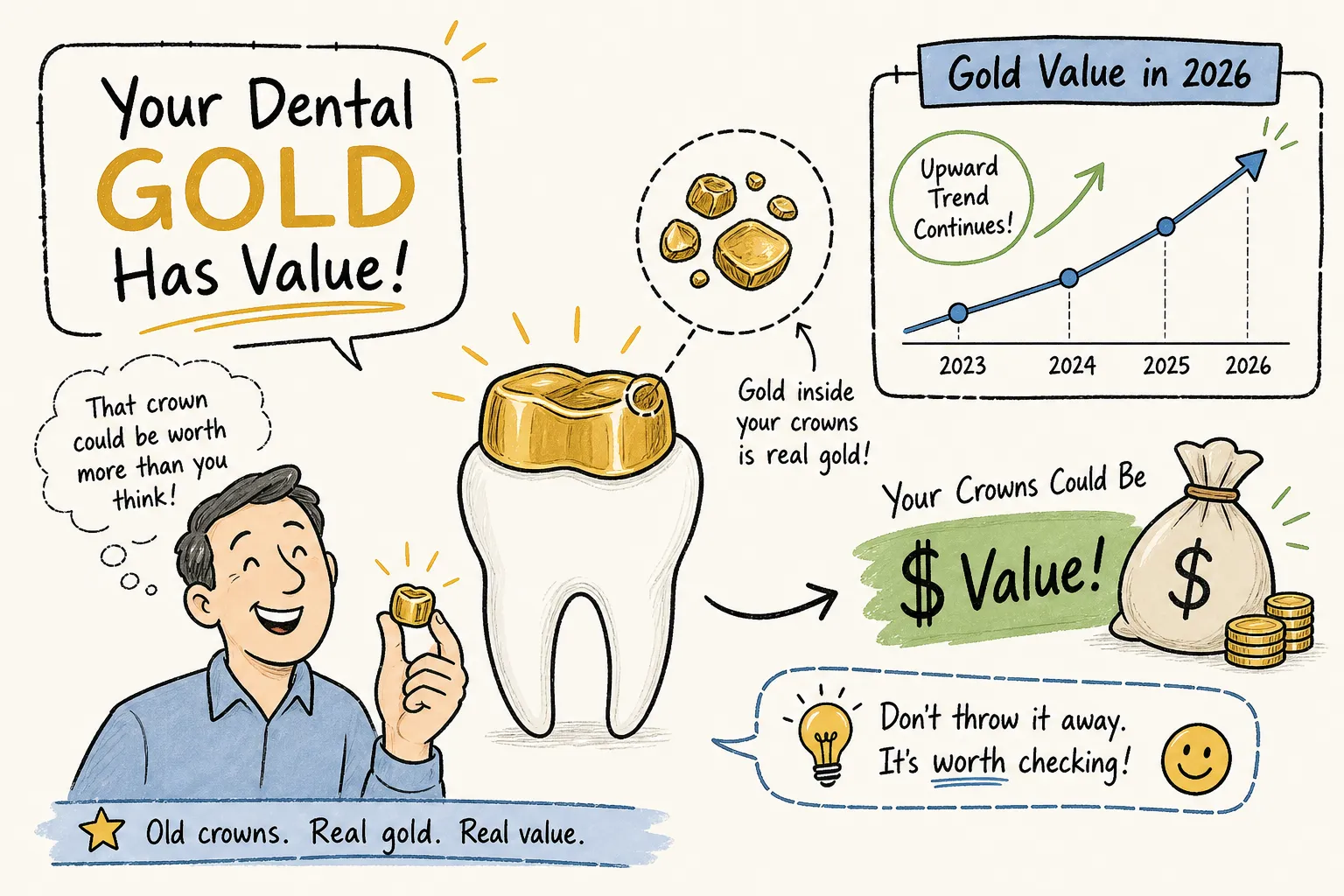
Somewhere in a drawer or a small bag from a dentist's office, you might have a handful of gold crowns that belonged to a parent or grandparent. Maybe your own dentist recently replaced a crown and handed you the old one. The dental gold value of those pieces is easy to underestimate, it's tempting to assume they're too small or too unusual to be worth anything. That assumption costs people real money.
Dental gold has genuine, calculable value tied directly to the live gold market. With gold trading above $4,400 per troy ounce in 2026, even two or three old crowns can translate into a couple hundred dollars of cash sitting in that drawer. The math is straightforward once you understand two numbers: karat and weight.
At KC Gold and Silver in Kansas City, dental gold comes in regularly and gets treated the same as any other gold item. It's weighed, tested, and priced against the live spot price, no guesswork, no hidden deductions. This article walks you through how dental gold alloys work, how the value calculation runs, what buyers actually pay, and how to get the most for your pieces when you're ready to sell.
What Dental Gold Is Actually Made Of
The Karat Ranges Used in Crowns and Bridges
Dental gold isn't the same alloy you'd find in a ring or a necklace. Dentists have used gold alloys for crowns, bridges, inlays, and onlays for over a century because gold is biocompatible, durable under biting pressure, and easy to shape precisely. The tradeoff is that dental applications use varying purity levels depending on the restoration type and the era when the work was done.
Most dental work falls somewhere between 10K and 22K gold, with 14K and 16K being especially common for full crowns. High-noble alloys, defined by more than 60% total noble metal content (gold, platinum, and palladium combined), show up frequently in posterior crowns where strength matters most. Typical high-noble crowns used for posterior strength often contain 65% to 75% gold by weight. Karat directly reflects the gold percentage: 14K is 58.3% gold, 18K is 75%, and 22K is 91.6% pure gold.
Why Not All Dental Pieces Carry the Same Gold Content
Older crowns, particularly those placed before the 1980s, often used higher-karat alloys. Modern dental work sometimes blends platinum or palladium alongside gold, which can actually push the piece's total precious metal value higher than you'd expect from the gold alone. Some pieces are porcelain-fused-to-metal restorations, which still have a gold alloy base worth recovering even if the visible surface looks like ceramic.
Without a proper assay test, you genuinely cannot determine the karat by looking at a crown. Color and age offer rough hints, but professional testing is the only way to know what you actually have. A reputable buyer tests on-site, typically using XRF (X-ray fluorescence) analysis, which is non-destructive and highly accurate, or acid testing as an alternative, before quoting you a number.
How Much Does a Gold Crown Actually Weigh?
Typical Weight Ranges by Piece Type
A standard gold crown weighs roughly 2 to 4 grams, with 3 grams serving as a practical benchmark for most calculations. Full molar crowns can push slightly heavier, closer to 4 to 4.5 grams, because back teeth require more material. For perspective, a U.S. dime weighs about 2.27 grams, so a typical crown is the weight of one to two dimes. Small, yes, but not insignificant when gold is trading above $140 per gram.
Partial crowns, inlays, and onlays weigh less, often under 2 grams. Bridges that span multiple teeth can weigh 6 grams or more, which makes them meaningful pieces when you're calculating what you have. If you've got a bag of several mixed dental pieces, the total weight adds up faster than most people expect.
Why Weight Alone Doesn't Tell You Much
Raw weight only gives you part of the picture. A 4-gram crown at 10K contains far less pure gold than a 3-gram crown at 18K, so heavier doesn't automatically mean more valuable. The real driver of dental gold value is pure gold content, the product of weight and purity combined. The next section shows exactly how to run that calculation.
How the Dental Gold Value Calculation Works
Converting Karat to Pure Gold Content
The conversion is simple: divide the karat number by 24 to get the gold purity as a decimal. A 14K piece is 14 divided by 24, which equals 0.583, meaning 58.3% of its weight is pure gold. Here's a quick reference for the four most common dental karats:
- 10K: 41.7% pure gold
- 14K: 58.3% pure gold
- 18K: 75.0% pure gold
- 22K: 91.6% pure gold
Running the Numbers: Price Per Gram for Dental Gold
One troy ounce equals 31.1035 grams. With gold at approximately $4,415 per troy ounce in 2026, the price per gram for dental gold works out to about $141.96, and that's the figure you plug into the formula. The full melt value calculation is: Melt Value = Weight (grams) × Gold Purity × Spot Price per Gram.
A Worked Example with a 14K Crown
Take a 14K crown weighing 3 grams. Pure gold content equals 3 multiplied by 0.583, which gives you 1.75 grams of actual gold. Multiply 1.75 by $141.96 and you get a melt value of approximately $248.43. That's the theoretical maximum based on the raw metal alone.
Run the same calculation on a lighter 10K crown at 2 grams: 2 multiplied by 0.417 equals 0.834 grams of pure gold. At $141.96 per gram, the melt value comes to about $118.40. These are melt values, not what a buyer pays, but they give you a clear ceiling to work from when evaluating any offer on your gold crowns.
What Buyers Pay Versus the Actual Melt Value
Why the Offer Is Always Below Melt Value
Every buyer builds a margin into their offer to cover refining costs, testing equipment, overhead, and their own profit. This is standard across the industry and not a sign of anything shady. The question worth asking isn't whether there's a margin, but how large that margin is and whether the buyer can explain it clearly.
Reputable precious metals buyers typically offer 60% to 80% of melt value for dental scrap, with buyers who have direct refining relationships sometimes reaching the higher end of that range. The key indicator of a fair deal is transparency: a good buyer shows you the math openly so you understand exactly what you're getting and why.
Pawn Shops Versus Reputable Gold Buyers
Pawn shops routinely offer 20% to 40% of gold value for dental pieces. That gap exists because pawn shop staff aren't always trained to properly assay mixed dental alloys, and the business model depends on wide margins to cover the risk of reselling items in a general merchandise environment. A dedicated precious metals buyer tests the metal, calculates the offer against live spot prices, and can walk you through every line of the math.
The dollar difference is real. Using the 14K crown example from above: at 65% of the $248 melt value, a reputable buyer pays roughly $161. At a pawn shop's 30%, that same crown might fetch $74. That's an $87 gap on a single crown. If you have a bag of six or eight pieces, the difference scales accordingly.
How to Maximize Your Dental Gold Value When Selling
What to Bring and How to Prepare
Collect everything: crowns, bridges, inlays, partial plates with gold components, and any fragments. Even small pieces add up when gold is above $140 per gram. If you can remove obvious plastic or base metal components, go ahead, though a good buyer will sort through the material for you at no charge.
Don't clean, polish, or alter the pieces before bringing them in. Scrubbing changes nothing about gold content and can make visual inspection harder for the buyer. You also don't need to know the karat in advance. On-site testing is a standard part of the evaluation, and any reputable buyer handles it as a routine step.
What Transparent Testing Looks Like at a Reputable Buyer
A quality in-person evaluation follows a clear sequence: the buyer weighs each piece on a calibrated scale in front of you, tests purity using XRF analysis or acid testing, references a live spot price display, and shows you the full calculation before making an offer. Nothing happens behind a closed door, and no number appears without an explanation attached to it.
At KC Gold and Silver in Kansas City, each piece is weighed and tested with the customer watching. The offer is calculated directly from the live market price and shown to you before any decision is made. There's no fee for the evaluation, and there's no pressure to sell, you leave with a clear number regardless of what you decide.
Timing and What the Spot Price Means for Your Payout
Because dental gold value tracks directly with the live gold spot price, higher spot prices translate to higher offers in real time. With gold above $4,400 per troy ounce in 2026, this is a strong environment for sellers. If you're not in a rush and have a larger lot, watching the spot price over a few weeks and selling on a strong day can add a meaningful amount to your total payout.
What to Take Away Before You Bring Your Crowns In
Gold crowns and dental scrap carry real market value determined by two things: karat purity and weight. With those two numbers and the live spot price, the dental gold value calculation is straightforward, and the result often surprises first-time sellers. A few old crowns at 14K or 18K can easily put $150 to $300 or more in your pocket, and a collection of pieces from an estate can run significantly higher.
The difference between a fair offer and a low one comes down entirely to who does the testing and how openly they show their math. A buyer who weighs, tests, and prices against live spot in front of you is the buyer worth working with. One who gives you a flat number without explanation is one worth walking away from.
If you're in the Kansas City area and have gold crowns, bridges, or any dental scrap sitting unused, bring them into KC Gold and Silver for a free evaluation. No appointment needed, no obligation to sell. The offer is calculated right in front of you using today's live gold price, so you'll leave knowing the true dental gold value of your pieces, whether you sell that day or not.
Keep reading
September 13, 2026
Best Way to Sell Gold for Cash: A Step-by-Step Guide
Most people who sell gold walk away with significantly less cash than their metal was actually worth. The reason usually isn't a scam. It's that they…
Read more →
September 12, 2026
Gold spot price at record highs: what sellers should know
When the gold spot price hit a record high of $5,589.38 per troy ounce on January 28, 2026, seasoned dealers stopped mid-sentence. That was the highest…
Read more →
Find out what yours is worth
Bring it by our Lenexa shop for a free, no-pressure evaluation. We test and weigh in front of you, explain the math, and pay on the spot if you accept.