October 21, 2026 · KC Gold and Silver
Gold Karat Chart: What Every Stamp on Your Jewelry Means
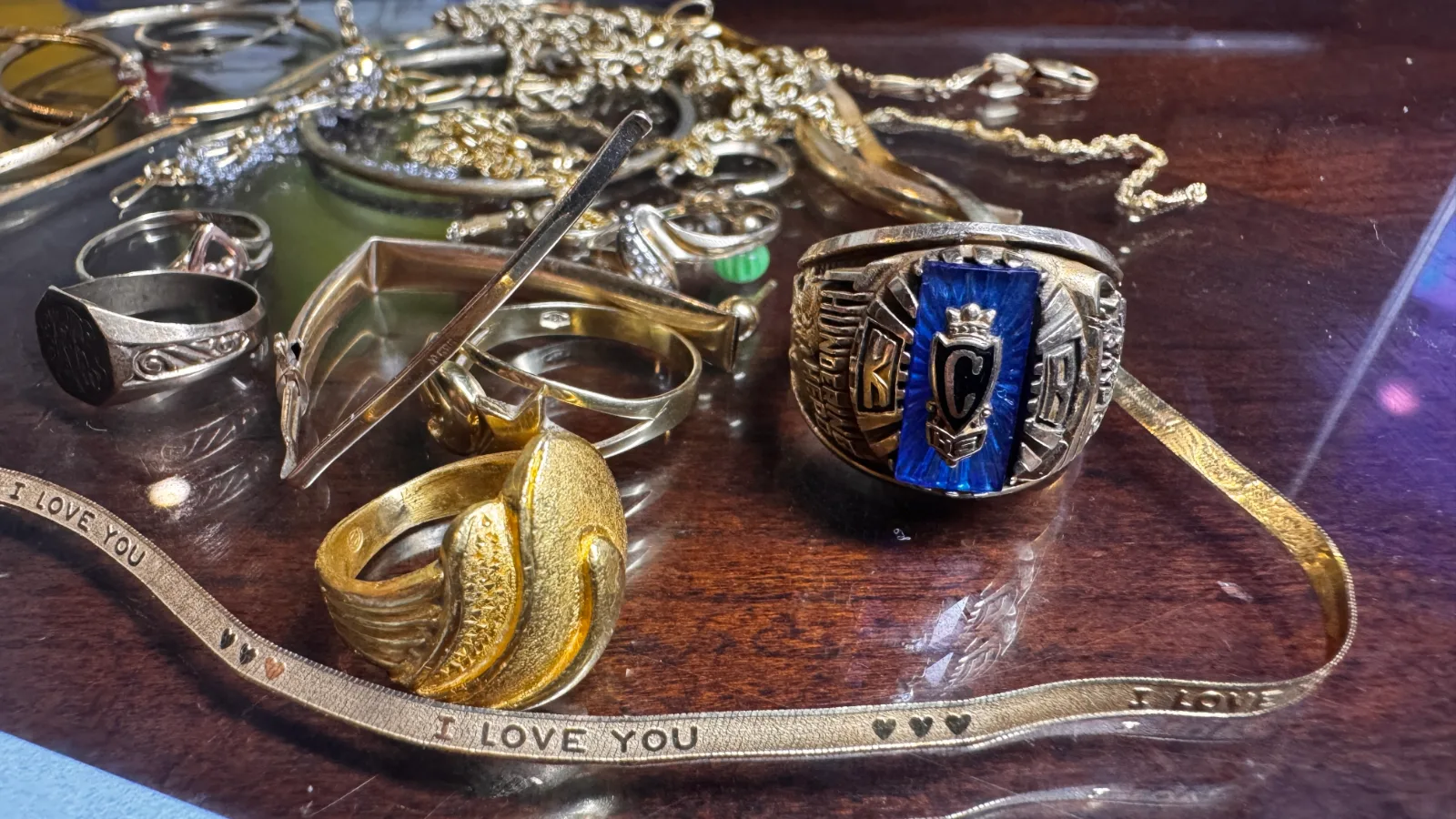
You turn an old ring over, tilt it toward the light, and find "585" pressed into the inside of the band. Most people look at that number, shrug, and put the ring back. It is worth knowing what it says. A gold karat chart turns every stamp on your jewelry into plain language, and once you can read the marks, a drawer of mystery pieces sorts itself into piles in a few minutes.
This guide is about identification only. It will help you work out what you are holding. It will not tell you what a piece is worth, because that depends on things that have to be weighed and tested on a real scale, and we do that in front of you at the shop in Lenexa.
The one sentence to remember
A karat stamp such as 10K, 14K or 18K, or a three-digit number such as 417, 585 or 750, tells you how pure the gold in a piece is, and it says nothing about the piece's weight or what it will fetch.
Everything below is detail on that idea. Purity is one fact about a piece. Weight, stones, and whether the item is solid or plated are separate facts.
Karat is not carat
The two words get mixed up constantly. Karat, written K or KT, is a measure of gold purity. Carat, written ct, is a measure of gemstone weight. A 14K ring can carry a one-carat diamond, and neither number changes the other. If a stamp has a K, it is talking about the metal.
The karat scale tops out at 24. A 24K piece is essentially pure gold. Every lower number means the gold has been mixed with other metals, usually copper, silver or zinc, so the piece is stronger and holds its shape.
A gold karat chart, stamp by stamp
Many pieces carry a three-digit number instead of a K. That is the fineness mark, the international way of writing the same purity. Imported jewelry and a lot of older European pieces use it, which is why a ring from a relative abroad can look like it is stamped in code. Here is how the two systems line up.
| Karat stamp | Fineness stamp | Where you tend to see it |
|---|---|---|
| 24K | 999 | Bullion bars and investment pieces |
| 22K | 916 | Gold coins, South Asian and Middle Eastern jewelry |
| 18K | 750 | Designer, estate and European-influenced jewelry |
| 14K | 585 | The everyday standard for American jewelry |
| 10K | 417 | Class rings, charms, many chains |
| 9K | 375 | Vintage British and European pieces |
In the United States, 10K and 14K are what you will find most often in a jewelry box. Ten karat is generally the lowest purity sold as gold jewelry here. Eighteen karat turns up in finer and older estate pieces. The higher numbers are rarer in rings and bracelets because very pure gold is soft.
Why some 14K pieces say 583
You may come across 583 instead of 585. Older Eastern European and Soviet-era jewelry often used 583, and modern standards use 585. Both mean 14K. We treat them the same at the counter.
The other marks on the inside of a band
A purity stamp is not the only thing stamped on jewelry. Here is what the common extras mean.
- A maker's mark or initials. A small logo or set of letters usually names the manufacturer or designer. It is not a purity mark.
- 925 or STERLING. This is silver, not gold. A bracelet marked 925 is sterling, and we buy sterling too.
- GF, GEP, HGE or RGP. These stand for gold-filled, gold electroplate, heavy gold electroplate and rolled gold plate. They mean a thin layer of gold over another metal. A piece that says 14K GF is gold-filled, not solid 14K.
- A country or assay mark. Imported pieces sometimes carry a small symbol for the country or testing office, next to the fineness number.
Plated and filled pieces are the most common surprise in a family jewelry box. A good rule: if the stamp has extra letters after the karat, read them before getting your hopes up.
When there is no stamp, or you cannot read it
A missing stamp does not mean a piece is not gold. Older handmade jewelry was sometimes never marked. Rings that have been resized can lose the stamp where the band was cut. Decades of wear rub marks away, especially on chains and clasps. Tiny stamps are also hard to read with the naked eye, and a jeweler's loupe helps.
An unmarked piece simply gets tested. At KC Gold and Silver the testing happens at the counter while you watch, so there is no mystery about what was found.
What karat changes, and what it does not
Color. Purer gold looks deeper and warmer. A 10K and an 18K yellow ring side by side look noticeably different. Rose gold gets its tone from copper, and white gold from white metals such as palladium or nickel. Color does not tell you purity. A white gold ring can be 18K, and a yellow gold one can be 10K.
Hardness. Higher karat gold is softer. That is why 14K and 10K are so popular for everyday rings. A scuffed 10K class ring has the same gold in it as the day it was made, whatever it looks like on the outside.
Weight. The stamp does not say how heavy a piece is. A thin, light 18K chain and a heavy 10K class ring are very different things, and a scale is the only way to tell them apart.
Stones. Diamonds and other stones are separate from the metal. They are set aside when the gold is weighed.
That last group of facts is why we do not put a number on anything from a photo or a description. For more on reading marks, see our gold karat guide.
Sorting the drawer before you come in
You do not need to clean anything or fix anything. Here is a quick way to get your pieces ready.
- Gather every piece, including the broken chains, the single earrings, and the pieces you suspect are costume jewelry.
- Look inside bands and on the clasp for a K stamp, a three-digit number, or letters like GF.
- Set apart anything marked 925 or sterling. Bring it along.
- Bring flatware, trays and tea sets as well if you have them. We buy sterling silver as well as gold.
If you want to see what the selling side looks like, our page on how to sell gold jewelry walks through it.
What happens at the shop
You set your pieces on the counter. We weigh them on a scale you can see, test the metal in front of you, and explain what we found, including the pieces that turned out to be plated. The evaluation is free, there is no pressure to sell, and if you do sell, the cash is paid the same day. Because the testing is done at the counter, nothing goes to a back room and nothing is sent away.
Questions about gold stamps, answered
What does 585 mean when it is stamped inside a ring?
It is the fineness mark for 14K gold. The number is the international way of writing the same purity that a 14K stamp shows, so the ring is 14K gold unless something else on it says otherwise.
Is karat the same as carat?
No. Karat measures the purity of gold, and carat measures the weight of a gemstone. A ring can be 14K gold and hold a diamond of any carat size.
Why does my ring say 583 instead of 585?
Both mean 14K. Older Soviet-era and Eastern European pieces often used 583, and today's marks use 585. At KC Gold and Silver we treat them the same.
What if there is no stamp on my gold jewelry?
Bring it in. Old handmade pieces, resized rings and worn chains often have no readable stamp, and we test the metal at the counter in Lenexa so you can see the result.
Does a higher karat always mean a better piece?
Not for wearing. Higher karat gold is softer and scratches more easily, which is why 14K and 10K are the usual choices for rings and everyday jewelry. A higher karat only means purer gold.
How do I reach KC Gold and Silver before I drive to Lenexa?
Call (913) 565-4653, which is also (913) 565-GOLD, or visit kcgoldandsilver.com. You can bring your pieces in as they are, and the evaluation is free.
Keep reading
October 26, 2026
Local Gold Buyer or Mail-In Service: The Real Difference
Selling a parent's gold jewelry as a family? See how a local gold buyer compares with a mail-in service when several people have to agree.
Read more →
October 25, 2026
Inherited Gold Jewelry: Pawn Shop or Gold Dealer?
Inherited gold jewelry and unsure where to sell? Compare pawn shops vs. gold dealers on price, transparency, and trust — then get the best offer possible.
Read more →
Find out what yours is worth
Bring it by our Lenexa shop for a free, no-pressure evaluation. We test and weigh in front of you, explain the math, and pay on the spot if you accept.