October 13, 2026 · KC Gold and Silver
Where to Sell Silver Flatware Near Me: Finding the Best Local Buyer
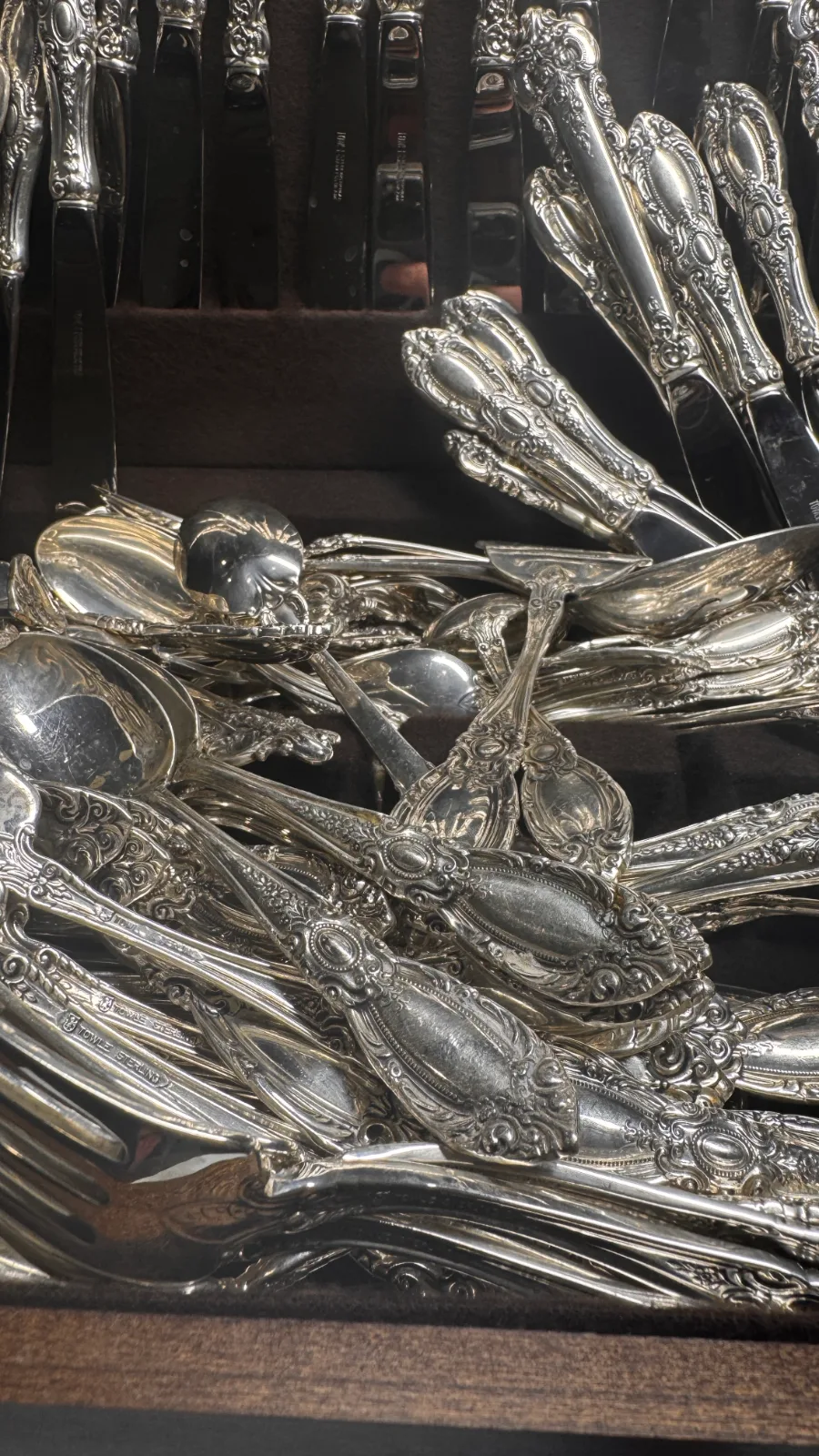
If you are searching for where to sell silver flatware near me, the first job is not picking a buyer. It is finding out what is actually in the box. Most flatware that comes out of a grandmother's cabinet or a parent's estate is wrapped in tarnished cloth, and nobody in the family is sure whether it is solid silver or an old plated set. The answer is usually printed on the back of the handle, and it takes about five minutes to read.
Once you know which one you have, the rest is simple. Here is how to tell, what a "full service" means, and what happens when you bring the set to our counter in Lenexa.
Sterling or silverplate: reading the back of the handle
Turn a fork or spoon over and look at the back of the handle, near the top or near the bowl. That is where makers put their stamps.
Marks that point to sterling:
- The word STERLING
- The number 925, which means 925 parts silver in every thousand
- On older English and some European pieces, small hallmarks such as a lion walking left
Marks that point to plate:
- EPNS, which stands for electroplated nickel silver
- EP, A1, AA, or the words "triple plate" or "quadruple plate"
- Names such as 1847 Rogers Bros, WM Rogers, or Community. These were made in huge numbers and are plated.
Some stamps look official without meaning much. Stars, shields and eagles on the back of a piece are decoration or branding. They are not a statement of silver content. Look for a word or a number instead.
Sterling is an alloy: mostly silver, with a small amount of another metal, usually copper, mixed in for strength. Plate is a base metal with a thin silver coating on top. The two can sit side by side in a drawer and look the same until you turn them over.
When the stamp has worn away
Stamps fade, especially on pieces that were used and washed for decades. Check the places that take the most handling: fork tines, the edges of the handle, the rim of a spoon bowl. A yellowish or coppery patch showing through can mean the coating has worn off a plated piece. Dark grey tarnish that stays even across the whole surface is more typical of sterling. Neither clue is conclusive on its own, and some plated pieces have a pale base that does not show color. If you cannot tell, that is fine. Testing settles it, and we do it in front of you at the counter.
What a full service of flatware contains
Sellers often ask whether they need a complete set. You do not, but it helps to know the vocabulary, because it explains why a drawer of silver can hold very different quantities.
A place setting is the group of pieces for one diner. A common one has a dinner knife, dinner fork, salad fork, teaspoon and soup spoon, and some patterns add a butter spreader or a dessert fork. A service for eight or twelve is that many place settings, usually with serving pieces: a serving spoon, a pierced spoon, a gravy ladle, a cake server, sometimes a carving set.
Plenty of what turns up is not a tidy set at all. It might be six teaspoons, a few mismatched forks and a sugar spoon. All of that can be looked at.
Hollow handles, steel blades and weighted pieces
Not every part of a sterling piece is solid silver, which is worth knowing before you bring anything in:
- Knives often have a stainless steel blade joined to a handle made of sterling. The handle is the silver part. The blade is not.
- Hollow-handled knives have a thin sterling shell filled with a different material to hold its shape.
- Weighted pieces, such as candlesticks, some trays and certain bowls, may have a sterling shell around a filler material at the base.
None of this is a problem or a reason to stay home. It only means that the weight on a scale is not all silver, and the person testing the piece should know that. We sort that out with you while you watch.
Where to sell silver flatware near me: what happens in Lenexa
If the marks say sterling and you want to sell, you can bring the pieces to KC Gold and Silver in Lenexa. Here is what the visit looks like.
- You set the flatware on the counter. Bring a government-issued photo ID, since we are required to ask for one when we buy.
- We look at the marks and test the pieces. Testing and weighing happen in front of you, not in a back room.
- We tell you what we can offer. The evaluation is free, and there is no pressure. If you would rather take everything home again, you can.
- If you say yes, you are paid in cash the same day.
A small set usually takes a short visit. A large estate with several boxes takes longer, because each piece gets looked at, but nothing needs to be sent away or left with us. For Kansas City-area sellers, there is also a page about our Kansas City-area locations. You can read more about the shop and who runs it on the about page, and there is a page set aside for selling silver flatware.
What condition matters and what does not
For us, tarnish, scratches, dents, bent tines, a monogram on the handle and a missing knife or two are all fine. They do not change what the piece is made of. Please do not spend an evening polishing before you come. Polishing is tedious, and it does not help here.
Bring more than flatware if you have it
We also like to see sterling bowls, trays, water pitchers and tea sets. Those larger pieces tend to be sitting in the same cabinet as the knives and forks. We are a dealer, so we cannot pay what a retail shopper would pay for a polished set on a dining table. That is the honest trade-off for a quick sale with cash in hand, and we would rather say it plainly up front.
Use it, or let it go
Some families would rather keep a set they will actually use. If you like polishing and you host holiday dinners, put it on the table and let the grandchildren see it. If the set has been in the cabinet for forty years, gets used for nothing, and the polishing sounds like a chore, bringing it to us is a perfectly good decision. Neither choice is wrong.
Our plain answer
If your flatware is stamped sterling or 925, it is solid silver, and KC Gold and Silver in Lenexa will test and weigh it in front of you and pay same-day cash if you decide to sell. If it is marked plate, we will tell you that honestly too, and you will have lost nothing but a short drive.
Flatware questions we hear in Lenexa
What if my flatware has no stamp at all?
Bring it in anyway. Marks wear off, and a few older or handmade pieces were never stamped. We test the piece at the counter while you watch, and you will know what it is before you decide anything.
Do tarnish, dents or a monogram cause trouble?
No. Those things change how a piece looks, not what it is made of. You can bring it in dull, scratched or engraved.
Do I need a complete set to come in?
No. A full service, a handful of spoons or a single serving piece are all welcome at KC Gold and Silver.
Will you buy knives with steel blades?
Yes, we can look at them. We know the blade is steel and the handle is the silver part, so you do not need to separate anything or explain it first.
Does it cost anything to have my silver looked at?
No. Evaluations at our Lenexa shop are free and there is no obligation to sell.
How do I reach KC Gold and Silver before I drive over?
Call (913) 565-4653, which is also (913) 565-GOLD, or visit kcgoldandsilver.com. If you have a large amount of silver, a quick call helps us plan enough time for you.
Keep reading
October 26, 2026
Local Gold Buyer or Mail-In Service: The Real Difference
Selling a parent's gold jewelry as a family? See how a local gold buyer compares with a mail-in service when several people have to agree.
Read more →
October 25, 2026
Inherited Gold Jewelry: Pawn Shop or Gold Dealer?
Inherited gold jewelry and unsure where to sell? Compare pawn shops vs. gold dealers on price, transparency, and trust — then get the best offer possible.
Read more →
Find out what yours is worth
Bring it by our Lenexa shop for a free, no-pressure evaluation. We test and weigh in front of you, explain the math, and pay on the spot if you accept.